
Part of a series on the four readiness scales we use at Lean Rocket Lab.
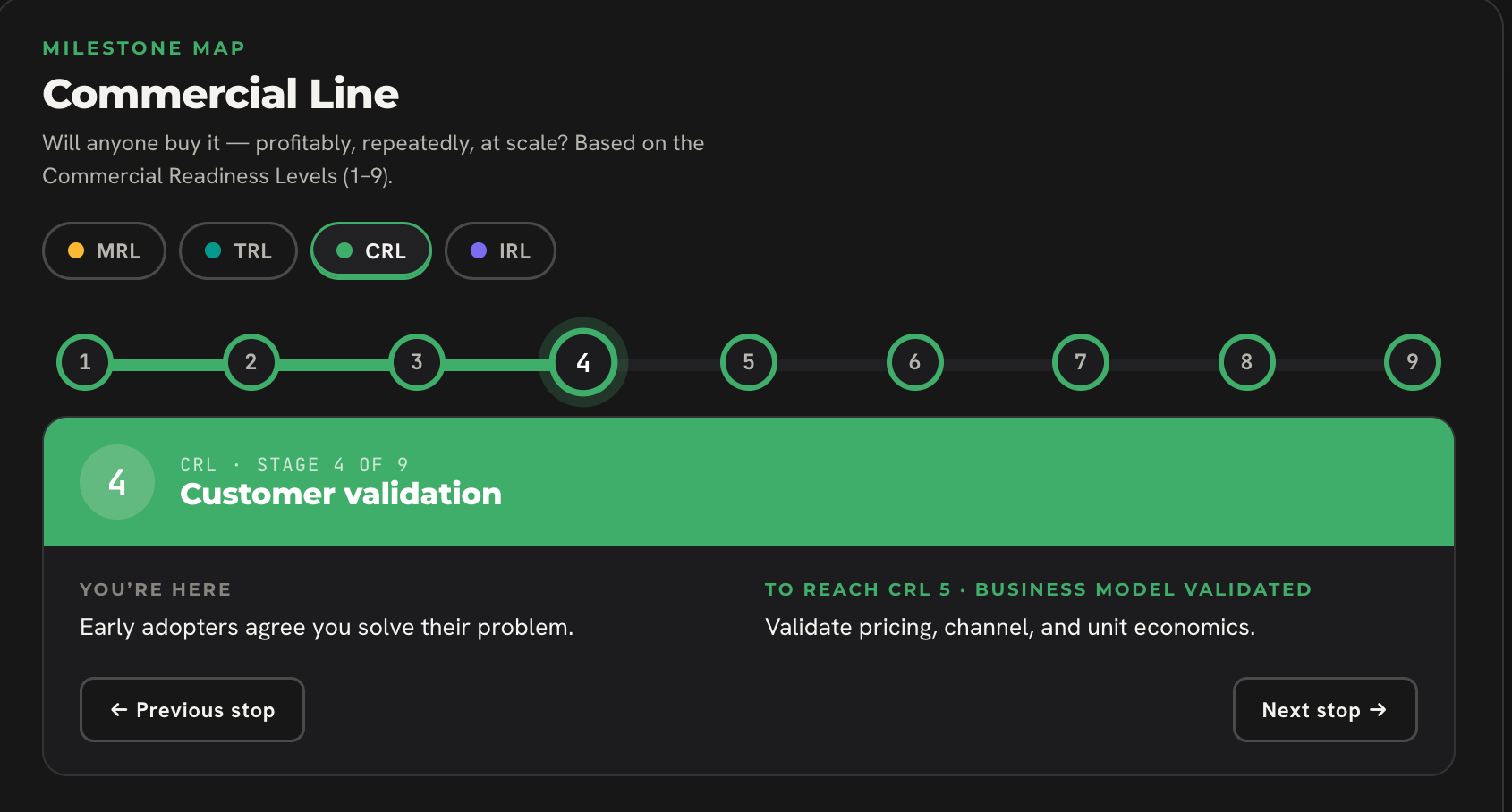
Commercial Readiness Level. Scored 1 to 9.
How proven your market is. Do you have customers, pricing, and a sales motion that repeats without you in every deal? High technology readiness with low commercial readiness is a common trap for founders.
Where it came from
This one has the messiest history of the four, and that is worth knowing rather than glossing over.
TRL has a clear origin: Stan Sadin at NASA in 1974. MRL came out of a Department of Defense working group with formal definitions in 2005. CRL has no single inventor and no single authoritative version. It was invented several times over, by different people, because everyone using TRL kept running into the same wall.
The wall was this. TRL tells you a technology works. It says nothing about whether the thing has a business around it. Funding agencies noticed they were backing technically excellent projects that went nowhere commercially, and they had no instrument to see it coming.
The most influential answer came in 2014 from the Australian Renewable Energy Agency, which built a Commercial Readiness Index. ARENA had a specific problem: a mandate to push renewable energy technologies toward commercialization, and limited public money to do it with. They needed to know where a dollar would do the most good, and TRL alone could not tell them.
Their index used six levels and was deliberately designed to begin where TRL starts to plateau and continue through the part of the journey TRL never covered. If TRL asks "does it work," ARENA's index asks "can this be financed?"
From there it spread and mutated. Other organizations adapted it, including Lloyd's Register and Innovation Fund Denmark. Universities built their own versions for technology transfer. Industry bodies defined nine level commercial readiness scales running from the initial belief that a technology could be commercially successful all the way through to full regulatory compliance, commercial availability, and broad acceptance in the target market.
So when you see CRL scored 1 to 9, as we score it, that is one of several legitimate conventions rather than a single canonical standard. The concept is solid and widely used. The numbering is not universal, and anyone who tells you it is has not looked.
What it actually measures
Strip away the variants and CRL is asking about evidence of demand, not belief in demand.
Roughly, the progression runs:
- Low. You believe there is a market. Maybe you have talked to people who agree. Nothing has been tested.
- Middle. Real customers exist. Money has changed hands. Pricing is being figured out. Each deal still takes heroics, and usually the founder.
- High. Sales repeat. Pricing holds. Customers arrive through a process rather than a personal relationship. Someone other than you can close.
That middle to high transition is where the real content of the scale lives, and it is the part founders consistently misjudge.
Why we use it at Lean Rocket Lab
Because it catches the failure mode that hurts the most.
High TRL and low CRL is the trap. You have built something genuinely impressive. It works. You are proud of it, and you should be. And nobody has committed to buying it.
What makes this trap so effective is that it feels like progress the entire time. The product keeps getting better. Every week there is something new working. It is measurable, satisfying, and entirely within your control. Meanwhile the risk that actually determines whether the company lives, whether anyone will pay for this, has not been touched, because touching it means hearing no from strangers.
CRL makes that gap visible as a number sitting next to your TRL. Two scores, side by side, and the story tells itself.
The most common mistake
Confusing having sold something with having a sales motion.
This is the distinction buried in the phrase "repeats without you in every deal," and it matters enormously. If every customer closed because you personally got on the phone, flew out, or knew them already, you have proven that you can sell. You have not proven that the business can.
That is not a knock on founder led sales. Early on it is the right approach and often the only one available. But it is a different thing from a repeatable motion, and treating them as the same is how companies hire a salesperson who fails, then conclude the salesperson was the problem.
A useful test: could someone you hired next month close a deal using what you have written down? If the answer requires you, your CRL is lower than your revenue suggests.
What CRL does not tell you
Whether you can deliver what you just sold.
A high CRL with a low MRL is its own kind of disaster: real demand, signed orders, and no ability to fulfill at volume. That failure is faster and more public than the quiet one, because now you have customers watching.
CRL also says nothing about the health of the business underneath. You can have strong commercial traction and still be one person doing everything with no cash buffer, which is what the Churchill stage is for.
Four scales, four different questions. CRL owns the one most likely to be answered with optimism instead of evidence.
Next in the series: Churchill, the five stages of small business growth, and the only one of the four that is not about the product at all.
Curious where you land? Our intake form scores all four readiness scales, and you get the results along with a conversation about what they mean for your business.